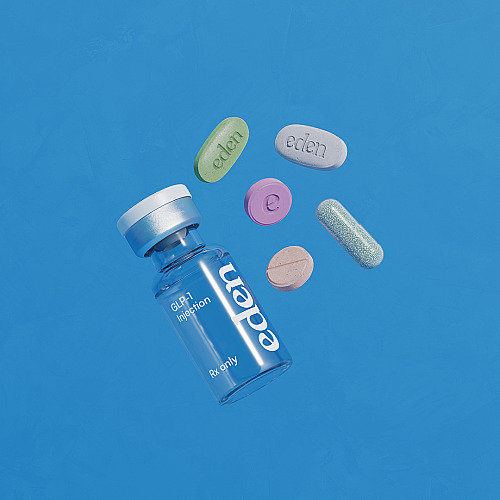
You’ve probably heard the news: The FDA ended the GLP-1 shortage. Tirzepatide was declared resolved in December 2024, followed by semaglutide in February 2025. If you’ve been researching Eden GLP-1 weight loss options, you might be wondering whether compounded GLP-1 therapies are still available and what that means for safety and legitimacy.
The regulatory landscape has changed significantly. While the shortage-related pathway for compounding has ended, Eden’s compounded GLP-1 therapy continues to operate through patient-specific compounding under Section 503A of the Federal Food, Drug, and Cosmetic Act. Understanding how this framework works matters if you’re evaluating your options.
Important: Compounded medications are not FDA-approved and may be prescribed only when clinically appropriate. A prescription from a licensed healthcare provider is required. Individual results may vary.
Understanding Compounded Medications

Compounded medications are not reviewed by the FDA for safety and effectiveness before reaching patients. However, they serve an important role for patients with specific clinical needs that cannot be met by commercially available products, such as specific dosing requirements, formulation adjustments, or other patient-specific medical considerations. Your healthcare provider determines clinical appropriateness based on your individual needs.
The Regulatory Landscape for Compounded GLP-1s

When FDA-approved medications like Wegovy® and Zepbound® were in short supply, compounding pharmacies were permitted under federal law to create “essential copies” during the shortage period. That exception ended when manufacturers demonstrated they could meet current and projected demand. Grace periods for shortage-based compounding ended in early 2025.
The pathway that remains requires patient-specific compounding under Section 503A. According to legal analyses, this requires a licensed prescriber to determine clinically significant, patient-specific need documented on each prescription.
The FDA has increased enforcement focus on compounded GLP-1 products. In February 2026, the agency announced plans to take “decisive steps” against companies mass-marketing compounded GLP-1 drugs, emphasizing that promotional materials cannot claim compounded products are the same as FDA-approved drugs. The regulatory framework distinguishes between patient-specific compounding and mass production, requiring compounding to be based on individual patient prescriptions with documented medical necessity.
The Eden Difference

Most telehealth providers avoid discussing regulatory status directly, leaving patients confused (or completely unaware) about what’s legal and what’s not.
Eden addresses these questions head-on. The program operates transparently with clear information about how the regulatory framework applies, which pharmacies compound medications, what accreditations those pharmacies hold, and what ongoing regulatory scrutiny means for patients.
What This Means for Patients
Board-certified physicians evaluate each patient individually
Prescriptions are written when a provider determines medical necessity
State-licensed 503A compounding pharmacies prepare medications to order
Compounding follows patient-specific formulation requirements
Medications undergo third-party testing for quality assurance
How Eden Approaches GLP-1 Treatment
A board-certified physician reviews your health history, weight loss goals, and medical profile to determine whether GLP-1 treatment may be appropriate. Only after clinical review can a provider prescribe a treatment plan.
Rebecca Emch, PharmD, serves as Eden’s VP of Pharmacy Operations, bringing over 17 years of pharmaceutical experience to the program’s quality oversight.
Transparent Pharmacy Partnerships

Many GLP-1 providers don’t disclose which pharmacies compound their medications, leaving patients uncertain about quality and accountability. Eden operates its own in-house pharmacy and publicly lists all partners.
Eden operates through a pharmacy network that includes Eden Pharmacy and quality-audited, US-licensed 503A partner pharmacies: GoGoMeds, Precision, Enovex, and AbsolutePharmacy. All pharmacies operate under state pharmacy board oversight and follow compounding standards for sterile preparation and serve all 50 states and Washington, D.C.
According to Eden’s website, their pharmacy network holds several industry accreditations. National Association of Boards of Pharmacy (NABP) accreditation verifies state licensing compliance. Pharmacy Compounding Accreditation Board (PCAB) certification indicates quality standards adherence. Accreditation Commission for Health Care (ACHC) and LegitScript certifications reflect additional safety and compliance verification.
Third-Party Testing for Quality Assurance

Eden’s partner pharmacies conduct third-party testing through FDA and DEA-registered laboratories. According to Eden’s website, every compounded lot undergoes quality control testing for potency (confirming appropriate active ingredient concentration), purity (verifying the target compound versus other materials), sterility (ensuring freedom from contaminants and pathogens per USP 797.1 standards), and bacterial endotoxin levels (meeting USP 85 threshold limits). These independent laboratory tests provide an additional quality control layer beyond standard compounding pharmacy requirements.
Patient Support and Treatment Outcomes

Eden has over 4,000 customer reviews on Trustpilot. Customers frequently highlight fast shipping, responsive support, and helpful care coordinators. Many reviews mention receiving medication quickly with proper insulated packaging and cold packs and getting timely responses when questions arise. Members reach the Dedicated Care Team anytime through the Private Health Hub.
According to Eden’s member survey data, patients who completed a six-month follow-up questionnaire reported an average weight loss of 29.3 pounds when combining compounded GLP-1 therapy with diet and exercise. The survey included 111 members using injectable GLP-1 treatments.*
Transparent and Predictable Pricing

The Eden GLP-1 program prices compounded semaglutide at $99/month (plus an active Eden Membership). Eden’s compounded tirzepatide is $199/month (plus an active Eden Membership). The Eden Membership is $39 for the first month, then $99/month after.
Payment options include monthly billing and buy now, pay later programs via Klarna and Afterpay. HSA/FSA reimbursement is also available.
Eden’s “Same Price at Every Dose” guarantee means your monthly rate stays consistent regardless of dose escalation. Many competitors increase fees when providers adjust dosages, but Eden maintains flat-rate pricing throughout treatment.
Free expedited shipping is included. Pricing is transparent and predictable, with no long-term contracts and no surprise bills.
Board-Certified Medical Team

Eden’s clinical team is led by Halland Chen, M.D., Chief Medical Innovation Officer, whose background spans longevity medicine, regenerative medicine, and functional medicine. The program’s Medical Advisory Board includes William Lee, M.D., who specializes in cardiology and chronic disease prevention, and Matthew Bennett, M.D., who focuses on anti-aging and regenerative medicine.
Eden’s licensed physicians evaluate patient eligibility based on clinical criteria. Not all patients qualify for GLP-1 treatment. Providers can decline to prescribe when patients don’t meet medical criteria or when compounded medications may not be appropriate.
Ongoing Care and Support
Eden membership includes four core support components:
Dedicated Care Team: Available anytime for questions about medication, side effects, or treatment progress
Member Experience Consultation: A 1-on-1 onboarding session to get members started on the right foot
Private Health Hub: A secure portal for managing treatments, messaging providers, and tracking progress
Access to the Eden Collective: A private member community for peer support and shared experiences
Providers conduct regular check-ins and can adjust dosing or treatment plans based on individual progress and response to treatment.
Making an Informed Decision
Choosing compounded GLP-1 therapy requires discussing risks and benefits with a qualified healthcare provider who can evaluate your individual medical needs. While many providers stay vague about regulatory status and pharmacy sourcing, Eden’s transparent approach helps patients make decisions with full understanding. If you’re researching compounded GLP-1 therapies, a consultation with a licensed provider can determine whether the Eden GLP-1 program aligns with your health profile and treatment goals.
Is your current provider being straight with you about how they operate?
*Based on self-reported member survey data. Results are not guaranteed.
The FDA does not review compounded medications for safety, effectiveness, or quality. Individual outcomes depend on multiple factors, including diet, exercise, and adherence to a treatment plan. This content is for informational purposes only and does not constitute medical advice. Consult a qualified healthcare provider before making treatment decisions. All details were verified at the time of publication and are subject to change without notice.







Leave a Comment
Your email address will not be published. Required fields are marked *